

Between Bullets and Bodhisattvas
On violence, vows, and the razor edge of liberation in America’s burning house after Charlie Kirk's murder

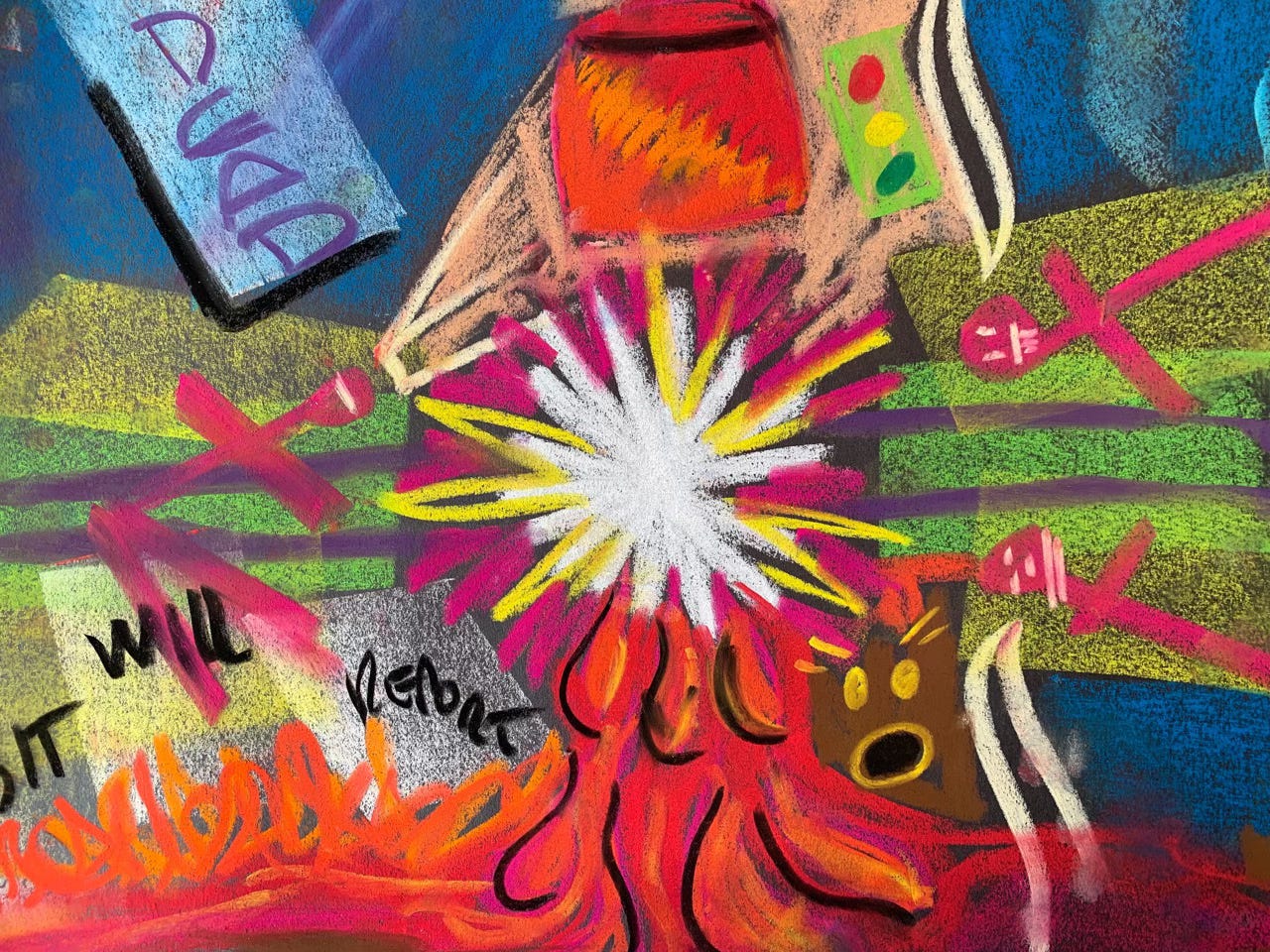
When samsara writes the script
Charlie Kirk was shot dead on a Utah college stage. He was speaking about guns—about the Second Amendment as America’s sacred cow—when violence returned to sender, a bullet ripping through the theater of certainty.
There’s a temptation in moments like this to flatten the story into morality play: “Tragedy!” “Justice served!” “Thoughts and prayers!” I refuse the simplicity. My body doesn’t cooperate with the script. It convulsed in shock when seeing the video of the moment he was shot.
Because here is the truth of my own reaction:
I don’t believe anyone should be shot. All violence is ugly, tragic, and heart wrenching.
I don’t mourn his death. Rather I mourn those who have been and will be harmed by his words, philosophy, and action network.
Relief and revulsion arrive together, two guests I didn’t invite but must host anyway. My chest loosens knowing his voice can no longer incite cruelty. My gut clenches because political murder corrodes what fragile commons remain. This is samsara—cause and effect playing out in grotesque synchrony, karma ripening in plain sight.
And if that paradox offends, so be it. Those who never felt his words pierce flesh will be the first to demand uncomplicated grief. If you are confused why some of us exhale at his death, it is because you never had to hold your breath in his presence. That incomprehension is its own privilege.
Violence is bigger than a bullet
We’re taught to see violence only in what explodes. But tell me what’s more violent: the single gunshot, or the decades of policy that suffocate slowly?
Food wasted while families starve.
Trans kids and LGBTQIA+ persons erasure and dehumanization.
Police budgets swelling while children are routinely shot and schools decay.
Black and Brown communities terrorized in daylight and courtrooms by systems of oppression.
Families evicted while luxury condos sit half-empty and the homeless are arrested.
That’s violence. Legislative violence. Economic violence. White-supremacist violence coded as “order.”
And Kirk—let’s not pretend otherwise—was a mouthpiece for that violence. He called civil rights legislation a “mistake.” He recycled antisemitic tropes about “Jewish money.” He exalted scripture that prescribes death for queer love. He openly admitted that the death of innocents was an “acceptable cost” for gun purity. He championed the Great Replacement theory. And these just gloss the surface regardless of his advocacy for free speech.
So no, I will not join the chorus demanding sanitized grief. If obituaries are part of history, these hagiographies must tell the truth.
Relief is not celebration
Here’s what so many insulated voices don’t understand: relief at his death is not celebration. It is release.
Sometimes the body responds to news of a tormentor’s death with laughter or sigh, not because we love violence, but because the shadow that stalked us has finally stopped moving. Relief is the unclenching after years of bracing. It is the body saying: enough.
For those who never felt his fire, this will feel callous. For those who buried friends, lost family, or were cast out of homes because his rhetoric hardened the hearts of loved ones—this moment lands differently. If you’ve never lived that, count yourself lucky. But don’t mistake luck for virtue.
The Buddhist razor
Buddhism does not let me off this hook with neat slogans. It gives me a razor.
Emptiness says nothing stands alone—not the shooter, not Kirk, not my relief. Every event is a knot of conditions and interconnection stretching backward and forward.
Karma reminds me that this moment is not an accident but the ripening of countless actions—seeds once planted bearing fruit as conditions converge.
Liberation says vows must confront the world as it is. A Bodhisattva vows to alleviate suffering—but what if alleviation sometimes means restraint, and sometimes means intervention with force?
The parable of the Bodhisattva ship captain haunts me: faced with a would-be mass murderer, he kills one to save five hundred, accepting karmic consequences so others might live. The lesson isn’t that killing is fine—it’s that intention, motivation, compassion, power, and deep wisdom are the heart of the matter.
And Thich Nhat Hanh sharpened it: stop the oppressor, but never from a place of hatred. Even a vegetarian meal kills bacteria; purity is impossible. The task is to walk in the direction of nonviolence, without mistaking passivity for peace.
That is the razor edge: to act fiercely without letting hate, ignorance, and lust colonize the heart.
Liberation with teeth
Liberation theology in Latin America called it “the preferential option for the poor.” James Cone thundered that if theology doesn’t speak from the underside, it isn’t Christian at all. Black radicals made it plain: nonviolent marches may shift the stage, but armed self-defense made white terrorists hesitate.
Malcolm X cut to the marrow: survival is not “violence,” it is intelligence.
History is clear—nonviolence alone rarely wins freedom. It was accompanied, shadowed, sometimes shielded by militant defense. This doesn’t mean vengeance is noble. It means struggles are plural, and liberation is tooth and tenderness braided together.
America’s wound
Aimé Césaire was prophetic: fascism is colonialism turned inward. America is now devouring itself with its own tools.
Settler conquest built on genocide.
Chattel slavery and its afterlife in prisons.
The Confederacy never defeated but reborn in think tanks and legislatures.
Evangelical fever dreams wrapped in the flag.
We never metabolized these poisons. We wrapped them in “culture wars,” exported them abroad, and pretended they weren’t our reflection. Now the boomerang arcs back.
So when Kirk dies at the altar of his own gun theology, it is not anomaly—it is symptom. The nation is tasting the fruit of its poisoned tree.
The trap of “higher ground”
Here’s the hypocrisy: the same politicians who told us not to “politicize” dead children in classrooms are now politicizing Kirk’s corpse with speed and precision. They found nothing to do after Columbine, after Sandy Hook, after Uvalde—except offer thoughts and prayers. But now they will act. They will act violently, not compassionately.
Already, the machinery is turning: his death is being pinned on trans kids, on immigrants, on “the radical left”—with no evidence. Kirk’s own playbook lives on in his mourners: demonize the vulnerable, assign blame, build new cages.
So yes, empathy for his widow and children is human. But don’t confuse that with a moral obligation to weep for him. Empathy is not infinite, and the first claim on it belongs to those still living under the weight of his words.
Holding multiplicity without paralysis
Here’s the paradox I refuse to collapse:
No one should be shot, not even Kirk.
Kirk cultivated and justified the very violence that ended him.
Relief at his absence does not make me monstrous.
Celebration of death is its own intoxication.
Nonviolence is the north star, but militant defense has also been necessary.
Obituaries for the powerful must name their harms.
Empathy for his family does not equal amnesia for his victims.
This is not moral confusion. It’s moral honesty in a world built on contradictions.
Trans life, “acceptable costs,” and the politics of disposability
Kirk’s death also throws into relief who is considered disposable. He treated gun deaths as “worth it.” He advocated stripping trans people of healthcare and dignity. He aligned himself with movements that smiled while legislating queer and trans erasure.
So when people say, “no one deserves violence,” I hear the unspoken exception: unless you’re trans, unless you’re queer, unless you’re poor, unless you’re Black, unless you’re a migrant. Then your death is an “acceptable cost.”
This is why neutrality curdles. Because neutrality is never neutral—it always tilts toward power.
What to do with relief
I admit it: my shoulders dropped when I read the headline. Relief washed through me. Relief that his voice—his relentless cruelty—was gone.
That relief does not mean I sanctify assassination. It means I am human.
The discipline is what I do next through deep inquiry:
Do I mistake my relief for justice?
Do I let it ferment into hate?
Or can I let it pass, and use the clarity it offers to act more fiercely, more honestly, without feeding hate?
Thich Nhat Hanh’s counsel echoes here: stop the cruelty and harm, but not from a heart filled with hatred. That is the fiercest practice of all.
Who suffers first
This moment is dangerous—not because the violence happened, but because of how it will be used. Watch closely: the crackdown will not fall on those who profited from Kirk’s gospel of guns. It will fall first on immigrants, refugees, trans kids, Black communities, Muslims, queer activists. They will be blamed without evidence, scapegoated for the theater of control.
His death will be leveraged as pretext: “never again” but only for men like him. This is how fascism feeds itself—every corpse a tool, every tragedy a weapon.
Praxis for scorched times
So what does a liberatory praxis look like in this moment?
Expand what we call violence. Gunshots are violence. So are policies that erase groups of people, strip trans youth of healthcare, and vilify religious communities other than Christianity. So is eviction, bigotry, and support of genocide. Name them all.
Hold paradox as discipline. Contradictions don’t paralyze; they keep us honest.
Walk the Bodhisattva razor. Stop harm, even with force if needed, but refuse to be colonized by hatred.
Remember history’s plurality. Movements win with many tactics—nonviolent disruption and militant defense together.
Tell the truth about the dead. Refusing to varnish is not cruelty. It is clarity.
Widen empathy’s net. If you can feel for his widow, good. But don’t forget to hear the cries of his victims still living, still bleeding.
Closing the circle
Charlie Kirk’s death does not liberate us. Fascism does not soften because one of its apostles falls. Guns will not lose their worshippers.
But the moment reveals: how violence already saturates our nation, how vows strain under survival, how relief and horror can co-exist without resolution.
So I stand at the razor’s edge and say the only things I can live with:
No one should be executed.
I will not mourn.
And still—I carry him into my practice, forging a world where love outlives hate.