

When the Cross Becomes a Flagpole

It started, as so many things do these days, with a Facebook post. I had written, bluntly, in white letters on a red square background:
“After yesterday’s propaganda and merch event, so curious to see how many X’ians cannot make a distinction between Christofascism and the Gospel.”
It didn’t take long for the comments to come in. One fellow replied: “LMAO easy follow the holy spirit.”
I pressed him: “How do you practice discernment of spirits in this regard, to know the difference between the inspiration of the Holy Spirit and personal bias?”
His answer was as casual as it was empty: “As a Christian easy to discern…when you know you know…also what is christofacism?”
There it was in miniature: the shallow confidence that discernment is just vibes in religious packaging, and the ignorance—willful or not—of the long history of Christians colluding with authoritarian power.
This post is not about him. It is about what exchanges like this stir up in me. Because here is the truth: I left Christianity. I left not out of apathy, but out of heartbreak. The Catholic Church abandoned me, turned me out as a queer man who loved both sacrament and scripture, and made it clear I did not belong.
And yet, I never left Jesus.
Jesus, the One Who Haunts Me
When I read the Gospels, I still feel haunted by Jesus’ voice. He is not the mascot of empire or the poster boy of nationalism. He is the one who unrolled Isaiah’s scroll and declared:
“The Spirit of the Lord is upon me, because he has anointed me to bring good news to the poor, release to the captives, sight to the blind, freedom to the oppressed.”
That is liberation. That is the heartbeat of his message. And that is why I sometimes come off harsh toward Christians today—not because I despise them, but because I still revere the liberating current of Jesus’ teaching, and I hate seeing it traded for something else.
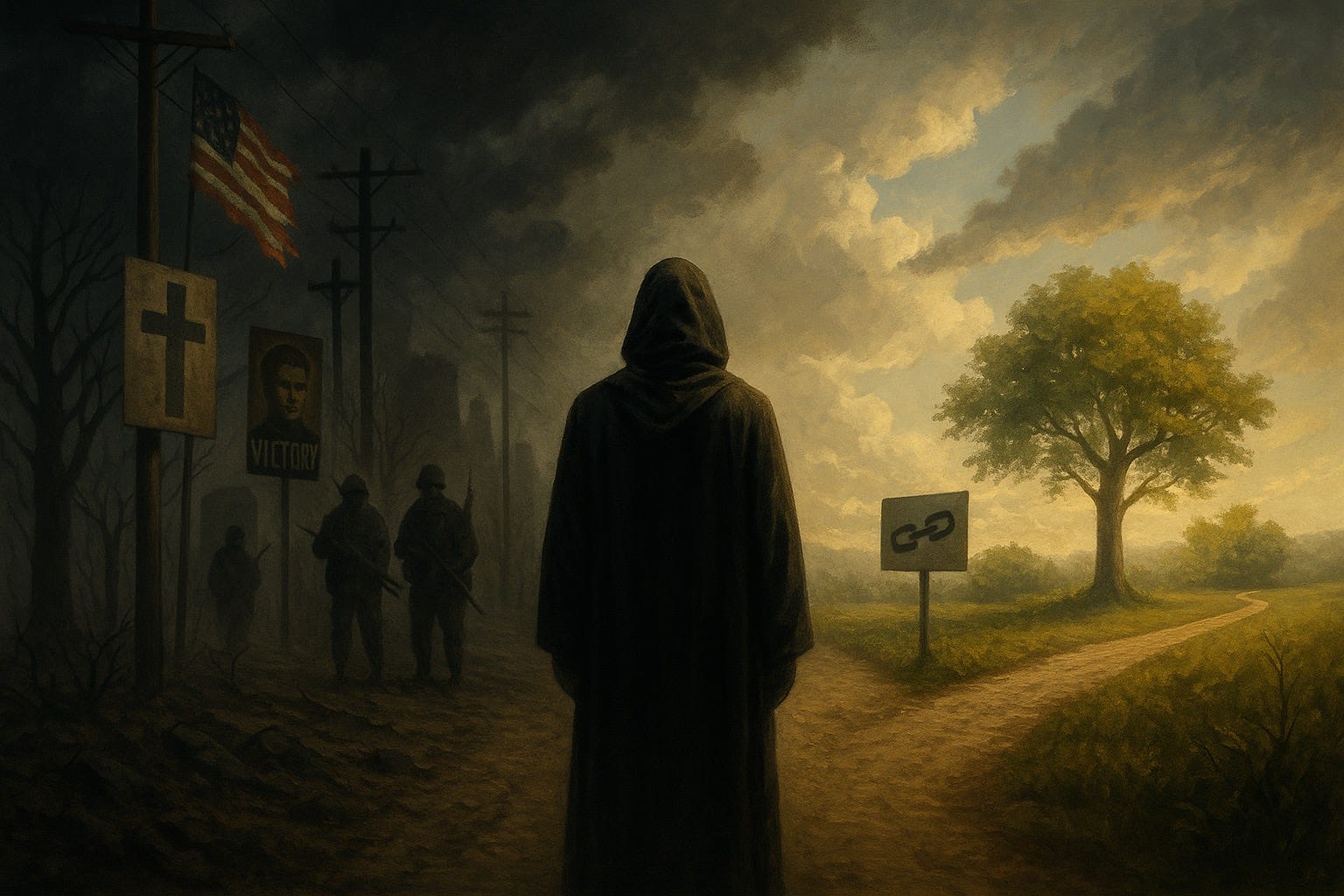
It isn’t a new story. Christianity has been bent toward empire, wealth, and domination again and again—whether Constantine’s state church, colonial missions, or the Inquisition. But now, in the United States, the move feels raw, naked, and brazen. The cross is not just being misread; it is being refashioned into a flagpole.
The Word We Need: Christofascism
Dorothee Sölle, a German liberation theologian, coined the word “Christofascism” to describe exactly this fusion of Christian language with authoritarian violence. She had lived through the Nazi period, when churches traded the Gospel for Führer and flag.
Christofascism is when Jesus’ words of mercy are drowned out by chants about walls, guns, and “real Americans.” It is when pulpits serve political propaganda. It is when worship becomes a merch table selling idols dressed in red, white, and blue.
This is not Christianity—it is Christianity weaponized. And yet, many Christians cannot or will not name the distinction. They treat critique of Christofascism as an attack on their faith rather than what it is: an attempt to rescue the Gospel from captivity.
Discernment Isn’t “When You Know You Know”
Which brings me back to my Facebook exchange. His comment—“When you know you know”—is the opposite of discernment. It is ego masquerading as divine clarity.
The early church knew better. The desert fathers and mothers spoke often about logismoi—the inner thoughts that deceive. Ignatius of Loyola mapped consolation and desolation as movements to test. Calvin warned against enthusiasm (Schwärmerei), mistaking private feelings for God’s voice.
Discernment has always been understood as difficult work, requiring testing, humility, waiting, fruit. The Spirit doesn’t bypass human judgment—it refines it.
“When you know you know” is not discernment. It is laziness. And laziness is fertile soil for propaganda.
Why It Hurts
Here is where I have to confess my own wound. My harshness comes from pain.
I left the Church because it refused to hold me, whereas Jesus could. I left Christianity because its institutions abandoned me and labeled me unworthy. But I still ache when I see the Gospel abandoned by those who stay.
It hurts to see neighbors weaponize Jesus against the very ones he came to lift up. It hurts to see the cross waved as a banner of conquest instead of a scandal of love. It hurts to watch Christians confuse nationalism with discipleship, cruelty with conviction.
The Church abandoned me once. Watching it abandon Jesus again—that cuts deeper.
The Cross vs. the Flag
The cross was Rome’s instrument of terror, transformed into God’s scandalous sign of life. It was a protest against domination, not a tool to reinforce it.
But today, too often, the cross has been lashed to a flagpole. And the flag has won.
The Gospel is always liberating news for the oppressed and always bad news for the oppressor. If your Christianity props up the powerful and silences the vulnerable, it has ceased to be Gospel.
What Discernment Demands
So how do we distinguish Spirit from bias, Gospel from propaganda, cross from flag?
The Christian tradition gives us at least four criteria:
• Scripture: Does it align with Jesus’ teaching of love, mercy, justice?
• Fruit: Does it bear compassion, humility, peace—or arrogance, cruelty, domination?
• Community: Is it tested by elders, saints, the body of Christ—not just my own conviction?
• Time: Does it deepen love over years, or is it a passing rush of zeal?
Discernment is slow, humbling work. It requires risking that we might be wrong. It requires asking questions more than asserting answers.
A Buddhist Lens on Discernment
When I left Christianity, I stepped fully into Buddhist practice and devote time to training as a Buddhist teacher. But I also offer interfaith direction, because the longing for discernment—the ache to know what is true and liberating—is not limited to one faith.
Buddhism, too, has wrestled with how to separate wisdom from delusion, clarity from ego. The methods differ, but the spirit is familiar.
• Examining Intention (Cetanā): Every action is judged by its root. Is it motivated by greed, hatred, or delusion—or by generosity, compassion, and clarity? Like Ignatius’ consolation/desolation, the test is the source of movement.
• Mindfulness of Thought (MN 20): The Buddha taught to notice thoughts, see if they lead to suffering, and, if so, replace them with more skillful ones. This is strikingly close to the Desert Fathers’ practice of exposing logismoi.
• The Middle Way: Discernment means avoiding extremes—indulgence and self-punishment, certainty and despair. The Benedictine virtue of moderation (discretio) is a Christian twin.
• Kalyāṇa-mitta (Spiritual Friendship): The Buddha declared that good friendship is the whole of the holy life. Discernment happens with companions, just as Christian direction happens in community.
• Examining the Fruits (Phala): The test is simple: does this action reduce suffering or increase it? Jesus said it too: “By their fruits you will know them.”
The Four Great Reliances:
1. Rely not on the person, but on the teaching.
2. Rely not on the words, but on the meaning.
3. Rely not on provisional meaning, but on definitive meaning.
4. Rely not on ordinary consciousness, but on wisdom mind.
These guardrails echo the Protestant insistence that the Spirit must align with Scripture rather than personality or impulse.
What emerges is a shared insight across traditions: discernment is not private certainty, but communal testing, ethical rooting, and attentiveness to fruit.
My Confession
I am not immune to bias, preference, or ego. I know how quickly my anger can dress itself up in righteous robes. My critiques can be sharp enough to wound.
But what matters is that I am trying to hold them to the light. I am testing, waiting, checking fruits. I do not want my voice mistaken for wisdom’s whisper.
And maybe that’s the best any of us can do.
Why I Stay in the Conversation
I left the Church. I left Christianity. But I did not leave Jesus. His words still echo in my heart.
That is why I keep engaging—on Facebook threads, in teaching rooms, in Substack essays. Not because I need to win arguments, but because I refuse to let Jesus’ name be co-opted by empire without resistance.
Buddhism has been my path for over 30 years. I may guide people of many paths. But when I see the cross traded for a flagpole, I feel compelled to speak. The prophetic spirit of justice and mercy live deep in my bones, like Mary, Isaiah, and Micah.
The Hard Work
Discernment is not easy. It is not “when you know you know.” It is work—slow, humbling, often painful work.
It is the work of untangling Spirit from ego, Gospel from propaganda, liberation from control. It is the work Christians and Buddhists alike have named: testing intentions, checking fruits, leaning on wise friends, resisting extremes, remembering that liberation is always the measure.
Because in the end, the question is not just whether we can tell the difference between cross and flagpole. The question is whether we will choose liberation when it costs us something.
The cross was never meant to be a flagpole. And if we let it be, we will lose not only the Gospel but our very humanity.